
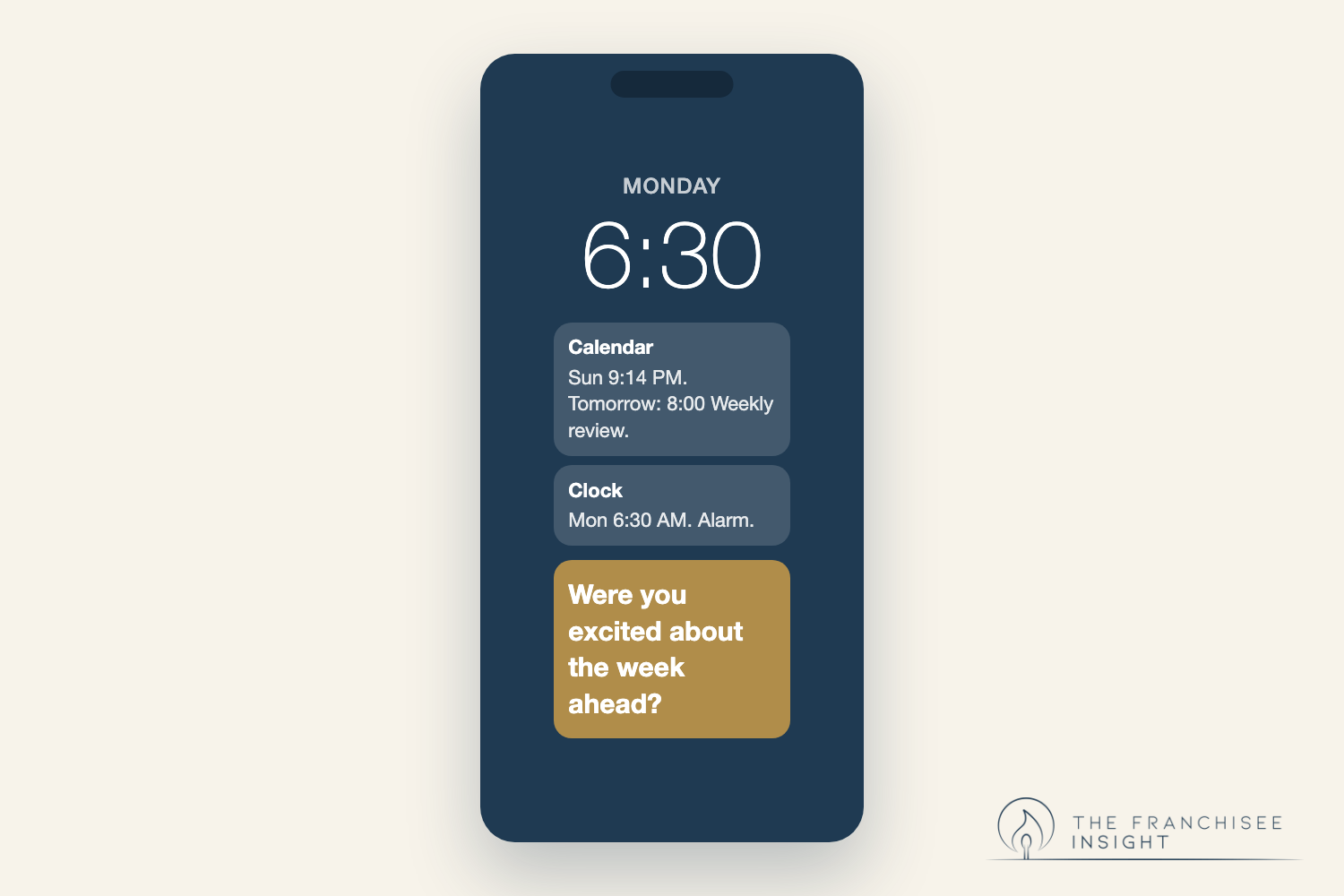
The Monday alarm
It's Sunday evening. The dishes are done, and the week ahead is already pressing in: the meetings, the deadlines, the expectations, another week of building someone else's business.
Then the alarm goes off on Monday morning, and a small question arrives before you're fully awake. Are you looking forward to today?
If the answer is yes, good. Plenty of people love their careers, and nothing here is meant to talk them out of it. This piece is for the people who answer more slowly.
The research on Mondays holds a surprise. In a Gallup survey of roughly 340,000 Americans, Monday moods were no worse than Tuesday through Thursday; moods were better on Fridays and weekends (Stone, Schneider and Harter, 2012). So if Sunday night feels heavy, Monday itself may not be the problem. The feeling might still deserve a closer look.
Why, then, do capable professionals hesitate to explore owning a business? Are the risks real, or is it how our minds handle uncertainty and loss? The research points to both, and it doesn't tell us which weighs more.
Successful and fulfilled are different questions
From the outside, it looks finished: the title, the pay, the equity, the respect. Some people in that seat are thriving. Others feel something is missing and can't quite name it.
Gallup's workplace research adds context. It found 31% of U.S. employees engaged in 2024, the lowest in a decade (Gallup, 2025). Engagement measures involvement and enthusiasm at work. It doesn't measure dread or who wants to own a business.
Regret offers another angle. A review of 11 regret-ranking studies found education and career were the two most-regretted areas of life, which the authors link to where we see our largest opportunities (Roese and Summerville, 2005).
What this does not show is that acting would have turned out better. Hindsight is generous. The popular line that people regret what they didn't try more than what they did is also more complicated than it sounds. Gilovich and Medvec (1995) found that actions tend to bring more regret in the short term and inactions more over the long run. Daniel Kahneman questioned how painful those long-term regrets really are, and a joint 1998 paper by Gilovich, Medvec and Kahneman concluded that some regrets about inaction are wistful while others are genuinely troubling. So treat the slogan as unsettled.
Why staying put feels natural
Status quo bias. In decision experiments, and in real choices by faculty members among health plans and retirement programs, people disproportionately stuck with what they already had (Samuelson and Zeckhauser, 1988). It describes a tendency, and staying put is often the right call.
Loss aversion. The idea is that losses weigh more than equal gains. Two 2024 meta-analyses put the effect at roughly 1.3 to 2 times, depending on the method and context (Brown et al., 2024; Walasek, Mullett and Stewart, 2024). A critical review argues that, on balance, the evidence does not show losses weigh more than gains (Gal and Rucker, 2018). It shows up on average in the meta-analyses, varies by method and is disputed: a tendency rather than a law.
Avoidance that looks like planning. A review of decision avoidance traced it to a mix of reason and emotion, chiefly cost-benefit calculation, anticipated regret and the difficulty of choosing (Anderson, 2003). From the outside, avoidance and careful planning can look identical. One way to tell them apart: can you name what the next round of research would answer, and by what date? Real diligence narrows. Each step rules something in or out, a process of mutual elimination. Avoidance circles back to the same questions with a new reason to wait.
Forecasting feelings. People tend to overestimate how long they will feel bad after a negative event (Gilbert et al., 1998). That concerns how long bad feelings last, not how likely a bad outcome is.
One large lab-in-the-field experiment, with 2,288 participants, compared entrepreneurs with managers and employees. The entrepreneurs rated themselves as less risk averse, but on incentivized tests they stood apart only in being less loss averse. On those tests they were no less risk averse than managers, and all three groups were alike in ambiguity aversion, meaning wariness of bets where even the odds are unknown (Koudstaal, Sloof and van Praag, 2016). The study cannot say whether ownership changes people or whether people who tolerate loss become owners. It does suggest that what sets owners apart is a greater willingness to bear a possible loss.
In a study of people torn over big decisions, a coin toss suggested whether to change or stay. Those who got the change result were more likely to make a change and reported greater happiness six months later (Levitt, 2021). The volunteers were self-selected and already on the fence, happiness was self-reported, and it was not a study of business ownership.
What the data say about fear
The Global Entrepreneurship Monitor's 2025/2026 global report describes fear of failure as "deterring 2 in 5 adults" (GEM, 2026). It gives no exact figure there, and GEM's current fear-of-failure rate counts adults who see good opportunities to start a business, not all adults (GEM, U.S. economy profile). The previous edition reported that nearly half (49%) of respondents in 2024 said they would not start a business due to fear of failure, up from 44% in 2019 (GEM, 2025). The two editions summarize the finding differently, so I would not read a trend between them. In the U.S., GEM puts it at "two in five" adults who see good opportunities, a proportion "fairly constant in recent years" (GEM, U.S. economy profile).
Three cautions. The global figures average many economies. They concern starting a business in general, not buying a franchise. They measure a self-reported attitude, so they show that fear is common but not that it is irrational or the main reason people stay put. I found no source that ranks emotional barriers against financial ones.
When perceived risk is greater than actual risk, and when it isn't
Where the caution is earned. In Bureau of Labor Statistics data on private-sector establishments opened in the year ended March 2016, 50.7% were still operating five years later and 34.2% after ten (BLS, Business Employment Dynamics). That counts every new private-sector location with employees, including new branches of existing companies; it is not a franchise figure. BLS records a location as closed when its employment drops to zero, and its data do not say why, so a closure is not always a failure.
Money matters as well. Hamilton (2000) found that most self-employed people in his U.S. data stayed in business despite lower starting earnings and slower earnings growth than in paid work, which he read as evidence of large non-money benefits. The data are decades old, so read it as directional. Health insurance is a legitimate constraint too. Among men, business ownership rises at 65, when Medicare begins, with no comparable jump at other ages from 55 to 75, which the authors read as some evidence of "entrepreneurship lock" (Fairlie, Kapur and Gates, 2011). For many executives, the hardest numbers are the ones they would walk away from: unvested equity, an annual bonus, deferred compensation, and benefits the family depends on. Add a mortgage, children and a spouse's income, and the concern is well founded. Planning a move around a vesting date can be sound judgment.
Where perception may run ahead of reality. Age may be less of an obstacle than some assume. For the 1-in-1,000 fastest-growing new ventures, the mean age at founding was 45.0 (Azoulay et al., 2020). That covers only high-growth ventures, which are neither typical businesses nor franchises. Wealth may also matter less than it seems. Hurst and Lusardi (2004) found the link between wealth and becoming an owner was close to flat across most of the wealth distribution. That finding is disputed (Fairlie and Krashinsky, 2012), comes from older U.S. household data, and does not transfer neatly to franchises, which often carry real capital minimums.
Does ownership make people happier? The evidence is mixed. The self-employed report higher job satisfaction even after accounting for income and hours (Benz and Frey, 2008). A 2023 meta-analysis covering 82 countries found the picture partly positive, depending on which aspect of wellbeing is measured and on the institutional setting (Stephan, Rauch and Hatak, 2023). These studies cover the self-employed in general, not franchise owners, and none of it guarantees happiness.
So which is it? Both. The financial and family risks are legitimate, and so are the psychological pulls. Opportunity cost runs in both directions: leaving gives up a paycheck you know, and staying gives up whatever you never tested.
That is why I'd frame the risk question this way. What if the biggest risk isn't leaving your career? What if it's spending another five years in a career you already know isn't making you happy, without ever exploring your alternatives? For some people the honest answer is still to wait, because a child is starting college or a spouse's job can't move. Waiting on purpose is different from waiting by default.
Evaluating is not committing
Evaluating an ownership opportunity and committing to one are separate decisions. Evaluating costs time and attention, and you can do it while still employed. Committing costs capital and is harder to undo. It is easy to let the fear that belongs to the second decision block the first.
The SBA describes franchising as giving you "more guidance but less control", and the contract usually benefits the franchisor more than the franchisee (SBA). Franchising does not remove financial or operating risk. Be wary of franchise success or failure rates quoted online; I haven't found a reliable official one.
By law, franchisors must give you the Franchise Disclosure Document at least 14 calendar days before you sign a binding agreement with, or make any payment to, the franchisor or an affiliate (16 CFR 436.2(a); FTC, 2020). Item 19, the financial performance information, is optional (16 CFR 436.5(s); FTC, 2020). And no government agency has verified what an FDD says; the rule requires its cover page to say so (16 CFR 436.3(e)(2)).
If you want to explore without committing, this is the order I'd suggest:
Fit first. Start with your lifestyle and family goals for the next three to five years, before any brand.
Capital and financing. Be realistic about what you could invest, and raise financing questions early.
The FDD. Start with Items 6, 7 and 19, then Item 20, and have a franchise attorney review it, not just an AI tool.
Validation. Talk to existing owners, including ones who left the system.
Advice and a downside case. Review the numbers with a CPA or financial advisor, and build a downside case next to the base case.
A decision date. Research without one can turn into avoidance.
You wouldn't buy a house after a single walk-through. You also wouldn't refuse to look at houses for the rest of your life.
Permission to look
You may be exactly where you want to be. If so, ignore all of this with my blessing. If not, give yourself permission to look at the alternatives with the same rigor you would bring to any major decision at work, without being rushed by fear, inertia, or anyone's sales pitch.
If it would help to talk it through, I'm glad to. I spent twenty-plus years in corporate and have owned franchises for thirteen years, and I'll tell you honestly when the right answer is to stay, wait, or take another path. I have people I tell not to buy a business.
Next Sunday night, when that feeling shows up, what would you want to know first?
Frequently Asked Questions
Is fear of failure the main reason people don't start a business?
The research doesn't say that. The Global Entrepreneurship Monitor's 2025/2026 global report describes fear of failure as "deterring 2 in 5 adults" (GEM, 2026). GEM's current fear-of-failure rate counts adults who see good opportunities to start a business, not all adults (GEM, U.S. economy profile), and the global figures average many economies. They measure a self-reported attitude about starting a business in general, not buying a franchise, so they show that fear is common but not that it is irrational or the main reason people stay put. I found no source that ranks emotional barriers against financial ones.
What is the failure rate for franchises?
I haven't found a reliable official franchise success or failure rate, so be wary of ones quoted online. The Bureau of Labor Statistics figure in this article (50.7% of private-sector establishments opened in the year ended March 2016 were still operating five years later) counts every new location with employees, including new branches of existing companies. It is not a franchise figure. BLS records a location as closed when its employment drops to zero, and its data do not say why, so a closure is not always a failure.
Can I explore franchise ownership while I'm still employed?
Yes. Evaluating an ownership opportunity and committing to one are separate decisions. Evaluating costs time and attention, and you can do it while still employed. Committing costs capital and is harder to undo.
When do I get the Franchise Disclosure Document?
By law, franchisors must give it to you at least 14 calendar days before you sign a binding agreement with, or make any payment to, the franchisor or an affiliate (16 CFR 436.2(a)). Item 19, the financial performance information, is optional (16 CFR 436.5(s)). And no government agency has verified what an FDD says; the rule requires its cover page to say so (16 CFR 436.3(e)(2)).
Does owning a business make people happier?
The evidence is mixed. The self-employed report higher job satisfaction even after accounting for income and hours (Benz and Frey, 2008), and a 2023 meta-analysis covering 82 countries found the picture partly positive, depending on which aspect of wellbeing is measured and on the institutional setting (Stephan, Rauch and Hatak, 2023). These studies cover the self-employed in general, not franchise owners, and none of it guarantees happiness.
Sources
Stone AA, Schneider S, Harter JK. 2012. "Day-of-week mood patterns in the United States: On the existence of 'Blue Monday', 'Thank God it's Friday' and weekend effects." Journal of Positive Psychology 7(4): 306-314. doi.org/10.1080/17439760.2012.691980 ; Gallup write-up (June 11, 2012): news.gallup.com
Gallup. 2025. U.S. employee engagement (published Jan 13, 2025; 2024 data): gallup.com
Roese NJ, Summerville A. 2005. "What we regret most... and why." Personality and Social Psychology Bulletin 31(9): 1273-1285. doi.org/10.1177/0146167205274693
Gilovich T, Medvec VH. 1995. "The experience of regret: What, when, and why." Psychological Review 102(2): 379-395. doi.org/10.1037/0033-295X.102.2.379
Gilovich T, Medvec VH, Kahneman D. 1998. "Varieties of regret: A debate and partial resolution." Psychological Review 105(3): 602-605. doi.org/10.1037/0033-295X.105.3.602
Samuelson W, Zeckhauser R. 1988. "Status quo bias in decision making." Journal of Risk and Uncertainty 1(1): 7-59. ideas.repec.org
Brown AL, Imai T, Vieider FM, Camerer CF. 2024. "Meta-analysis of Empirical Estimates of Loss Aversion." Journal of Economic Literature 62(2): 485-516. aeaweb.org
Walasek L, Mullett TL, Stewart N. 2024. "A meta-analysis of loss aversion in risky contexts." Journal of Economic Psychology 103: 102740. ideas.repec.org
Gal D, Rucker DD. 2018. "The Loss of Loss Aversion: Will It Loom Larger Than Its Gain?" Journal of Consumer Psychology 28(3): 497-516. doi.org/10.1002/jcpy.1047
Anderson CJ. 2003. "The psychology of doing nothing: forms of decision avoidance result from reason and emotion." Psychological Bulletin 129(1): 139-167. doi.org/10.1037/0033-2909.129.1.139
Gilbert DT, Pinel EC, Wilson TD, Blumberg SJ, Wheatley TP. 1998. "Immune neglect: A source of durability bias in affective forecasting." Journal of Personality and Social Psychology 75(3): 617-638. doi.org/10.1037/0022-3514.75.3.617
Koudstaal M, Sloof R, van Praag M. 2016. "Risk, Uncertainty, and Entrepreneurship: Evidence from a Lab-in-the-Field Experiment." Management Science 62(10): 2897-2915. econpapers.repec.org
Levitt SD. 2021. "Heads or Tails: The Impact of a Coin Toss on Major Life Decisions and Subsequent Happiness." Review of Economic Studies 88(1): 378-405. doi.org/10.1093/restud/rdaa016 ; working paper: nber.org/papers/w22487
Global Entrepreneurship Monitor. 2026. Global Report 2025/2026, "From Uncertainty To Opportunity" (published 26 Feb 2026): gemconsortium.org/report/51858
Global Entrepreneurship Monitor. 2025. Global Report 2024/2025, "Entrepreneurship Reality Check" (uploaded 17 Feb 2025): gemconsortium.org/report/51621
Global Entrepreneurship Monitor. 2025. United States economy profile: gemconsortium.org
U.S. Bureau of Labor Statistics. Business Employment Dynamics, Table 7, "Survival of private sector establishments by opening year" (data through March 2026): bls.gov ; Handbook of Methods, Business Employment Dynamics concepts: bls.gov
Hamilton BH. 2000. "Does Entrepreneurship Pay? An Empirical Analysis of the Returns to Self-Employment." Journal of Political Economy 108(3): 604-631. doi.org/10.1086/262131
Fairlie RW, Kapur K, Gates S. 2011. "Is employer-based health insurance a barrier to entrepreneurship?" Journal of Health Economics 30(1): 146-162. econpapers.repec.org
Azoulay P, Jones BF, Kim JD, Miranda J. 2020. "Age and High-Growth Entrepreneurship." American Economic Review: Insights 2(1): 65-82. aeaweb.org
Hurst E, Lusardi A. 2004. "Liquidity Constraints, Household Wealth, and Entrepreneurship." Journal of Political Economy 112(2): 319-347. econpapers.repec.org
Fairlie RW, Krashinsky HA. 2012. "Liquidity Constraints, Household Wealth, and Entrepreneurship Revisited." Review of Income and Wealth 58(2): 279-306. ideas.repec.org
Benz M, Frey BS. 2008. "Being Independent is a Great Thing: Subjective Evaluations of Self-Employment and Hierarchy." Economica 75(298): 362-383. ideas.repec.org
Stephan U, Rauch A, Hatak I. 2023. "Happy Entrepreneurs? Everywhere? A Meta-Analysis of Entrepreneurship and Wellbeing." Entrepreneurship Theory and Practice 47(2): 553-593. econpapers.repec.org
U.S. Small Business Administration. "Buy an existing business or franchise": sba.gov
FTC Franchise Rule, 16 CFR 436.2(a), 436.3(e)(2) and 436.5(s). Official text (GPO, 2024 edition): govinfo.gov ; Cornell LII: 436.2, 436.3, 436.5
Federal Trade Commission. 2020. "A Consumer's Guide to Buying a Franchise": ftc.gov
This article is for general education only and isn't legal, financial or investment advice. Requirements can vary by state and by offering, so talk to a franchise attorney and an accountant about your specific situation.
